Speech Delay
What is Speech Delay?
Speech delay is when the development of language is slower than expected, when a child has not met typical speech milestones at typical age markers.
Speech and language are two different terms with different meanings. Speech is the formation of words and sounds and the way we verbally express language. Language is giving and receiving information which can be verbal or nonverbal (body language, written language etc). For the purpose of this note, we are discussing speech delays.
Between 5% and 12% of children ages 2 to 5 years are diagnosed with a speech or language delay. [3] Another study claims that 15% of toddlers are 'late talkers' and 7% of children enter school with persisting impairments of their language development. [6]
Children with expressive delays have a delay in vocabulary and often show delayed development of sentence structure and articulation. Children with receptive delays show delays in comprehension/understanding. Both of these are assessed if a child is suspected to have a speech delay. [11]
Risk factors for speech delay include male sex, premature birth, low birth weight, late birth order, larger family size, socionomic adversity and domestic violence. [3]
There is currently no standardized way to measure or classify the severity of different types of speech delay. [9]
Children with signs of speech and language delay should undergo a comprehensive assessment and be considered for speech and language therapy. This assessment will include a hearing test and determine a child’s oral-motor capacity which affects how they chew and swallow food. A speech and language pathologist (SLP), along with a multidisciplinary team if necessary, should manage the interventions based on the identified root causes of the speech delay. [6] Interventions are often play-based and allow speech to be both taught, encouraged and practiced.
All individuals with ASD are eligible for speech-language services due to the pervasive nature of the social communication impairment. [5]
Signs/Symptoms
Some signs of speech delay include:
By 12 months old:
No babbling or use of gestures like waving or pointing
By 18 months old:
Prefers gestures over vocalizations to communicate
Has trouble imitating sounds
Has trouble understanding simple verbal requests
By 2 years old:
No use of spontaneous words or phrases
May say some sounds or words repeatedly
May mimic sounds/phrases that are heard
Has difficulty following simple directions
Potential Root Causes
The causes of speech and language delay vary.
Some children have neurodevelopmental conditions, such as autism spectrum disorder, which are related to a delay in speech. [9]
Mitochondrial dysfunction and/or hypotonia (low tone), particularly in the muscles of the face and mouth, may impact a child’s ability to form words and sounds appropriately.
Some children may have physiological conditions like a hearing impairment or an oral motor problem that cause a speech delay. [9]
Still others may have a speech delay with an unknown cause and this is referred to as Late Language Emergence (LLE). [11]
Next Steps
Nutritional Considerations for Speech Delay
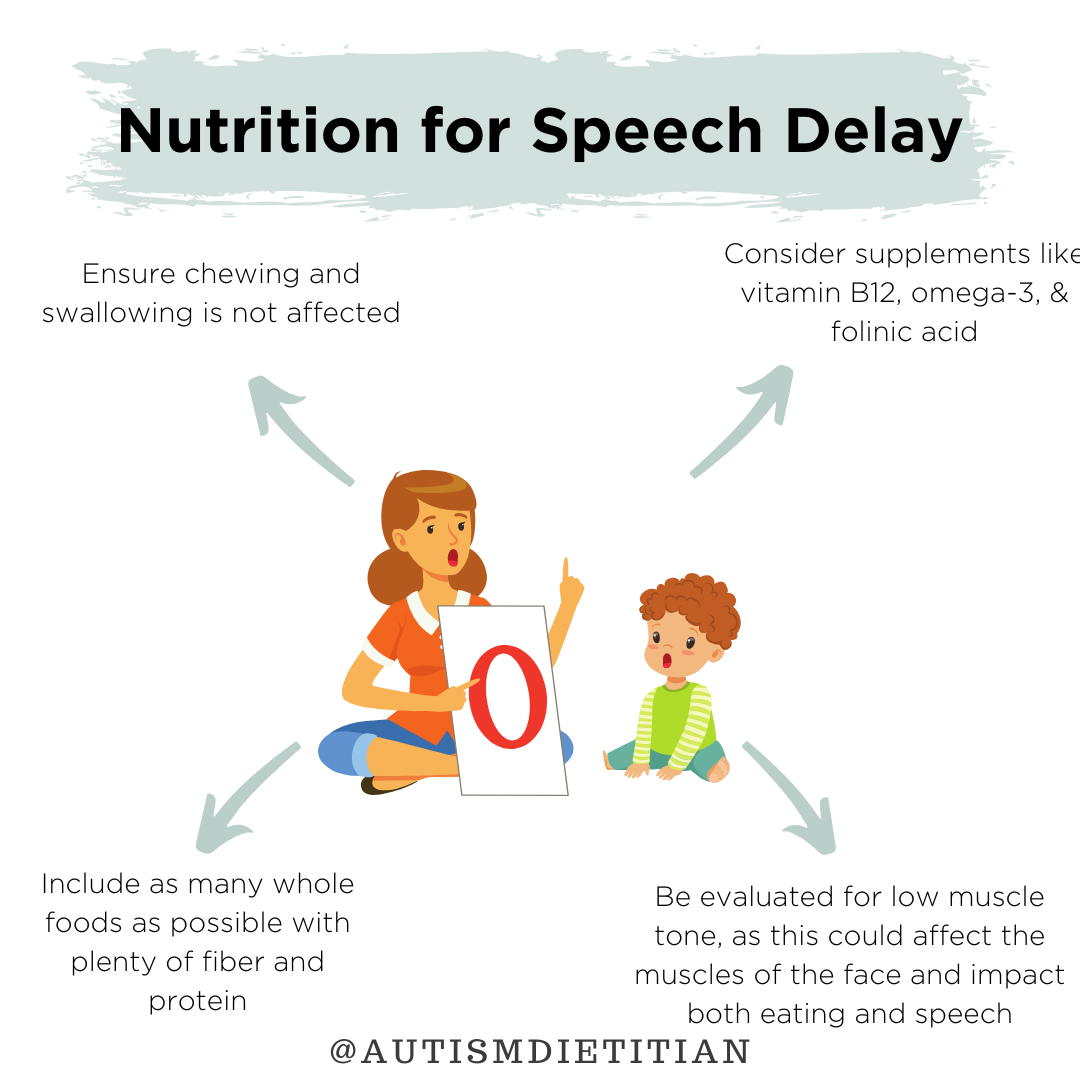
Ensuring that a child with speech delay is able to appropriately chew and swallow food is a huge nutritional concern and should be evaluated as soon as possible. Dangerous choking incidents can be traumatic and may create a fear of choking and or eating which could lead to picky or selective eating and imbalanced nutrition.
If the cause for speech delay is hypotonia, it is possible that there is low tone not only in the muscles of the mouth and face but also in the muscles of the trunk/torso. This will negatively impact a child’s ability to support themselves when it is time to eat and they may grow tired/fatigued and be unable to eat as much as they want or need. Using physical supports for a child with low tone is extremely important at meal time. The child should be supported under the feet and around their trunk so they can sit upright. A feeding therapist or occupational therapist can assist with this.
Supplement Considerations for Speech Delay
The following supplements have research to support their use in speech delay among those with ASD. Appropriate timing and dosing should be discussed with a healthcare provider:
Vitamin B12 (methylcobalamin) and Folic acid [16], especially in children with folate receptor autoantibodies which block folate uptake and cause cerebral folate deficiency which can cause speech delay. [8]
THB (tetrahydrobiopterin), required for the synthesis of neurotransmitters [10]
Omega 3 Fatty acids, with anti-inflammatory capabilities [10, 17]
Neuroprotek, with antioxidant and anti-inflammatory effects [10]
L-Carnitine [18], Ubiquinol [14] and Butyrate [15] which may improve mitochondrial function.
Sulforaphane for its ability promote cellular protective mechanisms [13]
L-Carnosine as a powerful antioxidant [12]
Lifestyle Considerations for Speech Delay
Modeling speech at home is a very important piece of the puzzle when it comes to speech delay. Talking with your child throughout the day, narrating your activities, singing, reading books and enunciating words and using gestures can all encourage speech development at home. [19]
For those children that are receiving speech therapy, it is important to consider, in the aftermath of COVID, whether or not the SLP or therapist is wearing a mask, as has been required of certain professions or in certain settings. The ability to see a therapist’s face as they enunciate and form words is an integral piece of speech therapy. It is important to ask or observe whether or not therapists are wearing face masks and potentially inquire about transparent face masks which can improve speech perception. [21]
DISCLAIMER: Before starting any supplement or medication, always consult with your healthcare provider to ensure it is a good fit for your child. Dosage can vary based on age, weight, gender, and current diet.
Speech Delay & Autism in the Research
Speech Delay and the Brain
Reduced gray matter in right cerebellar Crus I/I was related to ASD diagnosis, while children with early language delay showed additional reduced gray matter in left Crus I/II. These findings highlight the importance of specific cerebellar networks in both ASD and early language development, and suggest that bilateral disruption in cerebellar regions that interconnect with fronto-parietal networks could impact language acquisition in ASD. [2]
AS individuals with and without speech delay differ in visually guided and visually triggered behavior and show that early language skills are associated with slower movement in simple and complex motor tasks. [7]
Speech Delay & Interventions
Minimally verbal school-aged children can make significant and rapid gains in spoken spontaneous language with a novel, blended intervention that focuses on joint engagement and play skills and incorporates a speech generating device. [1]
Direct 1:1 intervention with a speech language therapist (SLT) can be effective for all areas of language for older children with developmental language disorder, regardless of their gender, receptive language or ASD status, or age. If direct 1:1 intervention can be effective with this hard-to-treat group, it may well also be effective with younger children with developmental language delay. Thus, direct SLT services should be available for school-aged children with developmental language delay, including older children and adolescents with pervasive difficulties. [4]
Consumers reported improvements in speech and oral motor skills, among others, with use of a blended vitamin and mineral meal replacement product (IQed Smart Nutrition composition) [20]
-
[1] Kasari C, Kaiser A, Goods K, et al. Communication interventions for minimally verbal children with autism: a sequential multiple assignment randomized trial. J Am Acad Child Adolesc Psychiatry. 2014;53(6):635-46.
[2] D'Mello AM, Moore DM, Crocetti D, Mostofsky SH, Stoodley CJ. Cerebellar gray matter differentiates children with early language delay in autism. Autism Res. 2016;9(11):1191-204.
[3] Othman A. Child Developmental Delays and Disorders: Speech and Language Delay. FP Essent. 2021;510:17-21.
[4] Ebbels SH, Wright L, Brockbank S, et al. Effectiveness of 1:1 speech and language therapy for older children with (developmental) language disorder. Int J Lang Commun Disord. 2017;52(4):528-39.
[5] Autism. American Speech-Language-Hearing Association. Accessed October 23, 2022.
[6] O'Hare A, Bremner L. Management of developmental speech and language disorders: Part 1. Arch Dis Child. 2016;101(3):272-7.
[7] Barbeau EB, Meilleur AA, Zeffiro TA, Mottron L. Comparing Motor Skills in Autism Spectrum Individuals With and Without Speech Delay. Autism Res. 2015;8(6):682-93.
[8] Frye RE, Slattery J, Delhey L, et al. Folinic acid improves verbal communication in children with autism and language impairment: a randomized double-blind placebo-controlled trial. Mol Psychiatry. 2018;23(2):247-56.
[9] Shriberg LD, Strand EA, Jakielski KJ, Mabie HL. Estimates of the prevalence of speech and motor speech disorders in persons with complex neurodevelopmental disorders. Clin Linguist Phon. 2019;33(8):707-36.
[10] Castillo MA, Urdaneta KE, Semprún-Hernández N, et al. Speech-Stimulating Substances in Autism Spectrum Disorders. Behav Sci (Basel). 2019;9(6):E60.
[11] Late Language Emergence. American Speech-Language-Hearing Association. Accessed October 23, 2022. https://www.asha.org/practice-portal/clinical-topics/late-language-emergence/
[12] L-Carnosine and autism. Nutrition Review. Published April 19, 2013. Accessed October 23, 2022. https://nutritionreview.org/2013/04/lcarnosine-autism/?fbclid=IwAR106WKQm2L_k_KgW2SotVP3GMfav6MpKHjud0uu1dASp6wPWUAqhedStEk
[13] Singh K, Connors SL, Macklin EA, et al. Sulforaphane treatment of autism spectrum disorder (ASD). Proc Natl Acad Sci U S A. 2014;111(43):15550-5.
[14] Gvozdjáková A, Kucharská J, Ostatníková D, Babinská K, Nakládal D, Crane FL. Ubiquinol improves symptoms in children with autism. Oxid Med Cell Longev. 2014;2014:798957. doi:10.1155/2014/798957
[15] Rose S, Bennuri SC, Davis JE, et al. Butyrate enhances mitochondrial function during oxidative stress in cell lines from boys with autism. Transl Psychiatry. 2018;8(1):1-17. doi:10.1038/s41398-017-0089-z
[16] Batebi N, Moghaddam HS, Hasanzadeh A, Fakour Y, Mohammadi MR, Akhondzadeh S. Folinic Acid as Adjunctive Therapy in Treatment of Inappropriate Speech in Children with Autism: A Double-Blind and Placebo-Controlled Randomized Trial. Child Psychiatry Hum Dev. 2021;52(5):928-38.
[17] Veselinović A, Petrović S, Žikić V, et al. Neuroinflammation in Autism and Supplementation Based on Omega-3 Polyunsaturated Fatty Acids: A Narrative Review. Medicina (Kaunas). 2021;57(9):893.
[18] Geier DA, Kern JK, Davis G, et al. A prospective double-blind, randomized clinical trial of levocarnitine to treat autism spectrum disorders. Med Sci Monit. 2011;17(6):PI15-23.
[19] Receptive and expressive language delays. Children’s Health Orange County. Published November 18, 2014. Accessed November 1, 2022. https://www.choc.org/programs-services/rehabilitation/frequently-asked-questions-receptive-expressive-language-delays/
[20] Geng L, Hamel F, Lewis D. Results of a Consumer Survey on the Effectiveness of a Nutritional Blend Reported on Autism Spectrum Disorder Symptoms, Apraxia, and Other Conditions Involving Motor and Speech Delays. Altern Ther Health Med. 2021;27(2):11-20.
[21] Zhou P, Zong S, Xi X, Xiao H. Effect of wearing personal protective equipment on acoustic characteristics and speech perception during COVID-19. Appl Acoust. 2022;197:108940.